Perspective
Depth depends on your viewpoint
A flat screen has no depth, yet a few slanted lines can make one object seem far away and huge. Compare the shapes below before you read why.
Look first: two bars on a track
Two teal bars lie across a pair of rails. Decide which bar looks longer, then check the paired diagrams.
Viewing steps
- Glance at the whole picture without measuring anything.
- Decide quickly which bar seems longer.
- Hold a piece of paper against the screen and mark the length of one bar.
- Slide the paper to the other bar and compare.
Reveal the explanation
Both bars are exactly 100 units long. This is the Ponzo illusion, described by the Italian psychologist Mario Ponzo in 1911. The converging rails suggest distance. An object that covers the same width on your retina while seeming farther away must, the brain reasons, be bigger in reality. So the upper bar is scaled up in your experience.
Size constancy at work
In daily life, a friend walking away from you does not seem to shrink, even though their image on your retina gets smaller. This is size constancy: the brain combines image size with estimated distance to keep the world stable.
Perspective illusions borrow that skill. They feed the brain convincing distance cues in a picture that is actually flat, and constancy does the rest.
The room that changes people
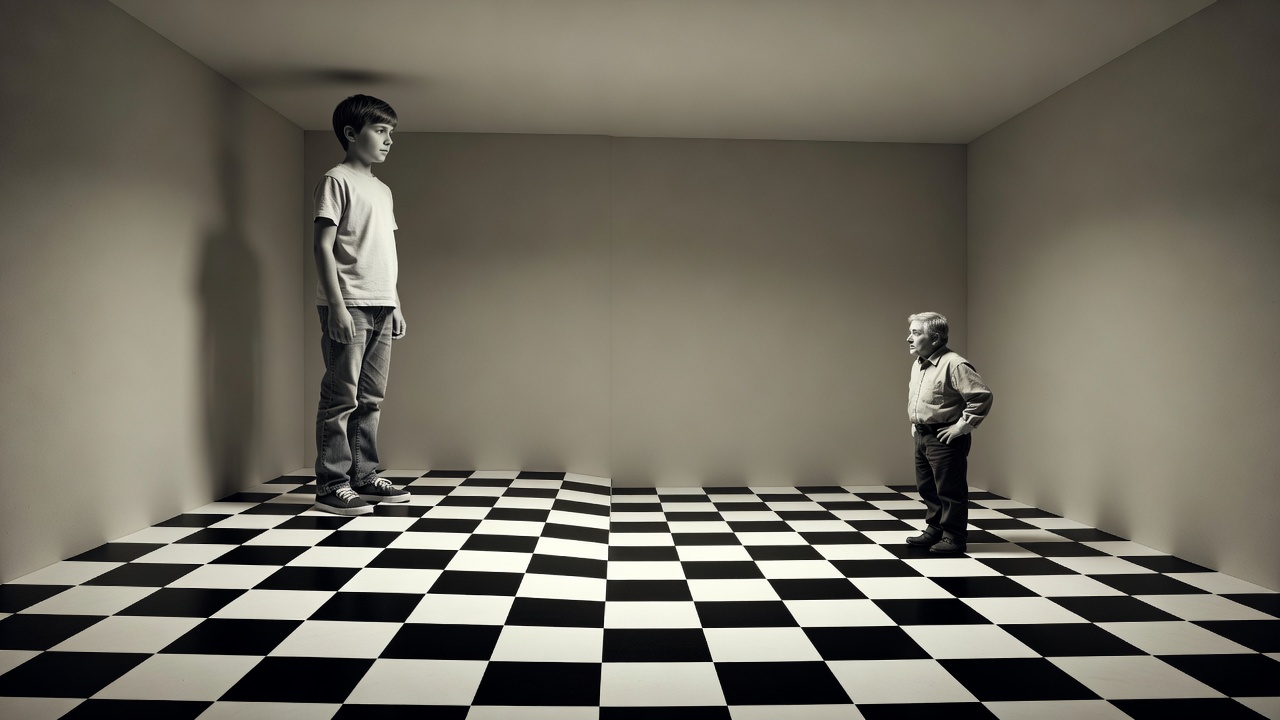
The American scientist Adelbert Ames Jr. built his distorted room in 1946. Viewed through a peephole, it looks like an ordinary rectangular room. In fact, one corner is much farther away than the other, and the floor and ceiling slope.
People standing in the far corner look tiny; people in the near corner look like giants. Many science museums, including the Exploratorium in San Francisco, have featured Ames rooms because the effect is so striking even when you know the secret.
Tables that will not match
In his 1990 book Mind Sights, the psychologist Roger Shepard presented two drawn table tops: one long and narrow, one nearly square. They are the same shape on paper, only rotated. The legs and edges make one table appear to recede into depth, so the brain stretches it.
Converging lines
Parallel edges that meet suggest a far distance.
Height in the scene
Objects higher in a picture often read as farther away.
Familiar size
Known objects, like people or doors, anchor our scale.
Forced perspective in photos
Holiday photos of people "holding up" the Leaning Tower of Pisa are forced perspective at its most playful. A camera, like a single eye, removes the depth information our two eyes would normally give. A near hand and a distant tower can then line up as if they touched.
Film makers use the same idea with scaled sets, and the 19th-century Beuchet chair trick seats a person on a chair whose legs and seat are actually far apart.
Compare the cues
| Effect | Main cue | What changes | Try this |
|---|---|---|---|
| Ponzo illusion (1911) | Converging lines | Perceived length | Cover the rails with your hands |
| Müller-Lyer illusion (1889) | Angled fins | Perceived length | See the annotated version on the home page |
| Ames room (1946) | Assumed rectangular room | Perceived size of people | Look for sloping floor lines in photos |
| Shepard tables (1990) | Table legs and edges | Perceived shape | Trace one top and rotate the tracing |
"Distance is not something we see. It is something we infer, and inference can be persuaded."Puff Puzzle Mang editorial note