Impossible Forms
Lines that refuse to become objects
These drawings look like solid things you could hold. Follow them carefully, though, and they quietly stop making sense. Look first; the reason follows below.
Look first: a triangle of beams
Three square beams seem to meet at right angles. Take your time and trace the shape with your eyes or a fingertip.
Viewing steps
- Cover two corners with your hands and look only at the third. Does it look like a real joint?
- Move your hands to check each corner in turn.
- Now uncover everything and follow the teal panel all the way around.
- Notice where the beam that seemed nearest ends up behind.
Reveal the explanation
Each corner is a perfectly reasonable right-angled joint. The trouble is that three right angles cannot close into a flat triangle in real space. Your visual system checks shapes in local pieces and is happy with each piece, so the global contradiction slips past until you trace the whole loop.
Who drew it first?
The Swedish artist Oscar Reutersvärd sketched an impossible triangle made of cubes in 1934, and went on to draw thousands of impossible figures. In 1958, the psychiatrist Lionel Penrose and his son, the mathematician Roger Penrose, published a short paper in the British Journal of Psychology describing the triangle and an endless staircase.
M. C. Escher took those ideas into art. His lithograph Ascending and Descending (1960) shows monks walking a staircase that never ends, and Waterfall (1961) shows water flowing downhill in a loop back to its own source.
Why the brain accepts it
When we look at a line drawing, we read junctions: places where lines meet in T, Y or arrow shapes. Each junction suggests which surface is in front. Impossible figures use correct junctions everywhere, so the local evidence is clean.
Narrow focus
Sharp vision covers only a small area, so we inspect drawings in sections.
Shortcuts
The brain assumes a drawing shows a possible object and builds one, piece by piece.
Late conflict
Only when the pieces are joined does the contradiction become noticeable.
The tuning fork that changes its mind
Another favourite is the blivet, sometimes called the devil's tuning fork, which circulated widely in the 1960s. Read from one end, it has three round prongs; from the other, two rectangular ones. The middle prong simply has nowhere to go.
It works for the same reason as the triangle: the ends are each convincing, and the transition is hidden in the part you look at least closely.
Can anyone build one?
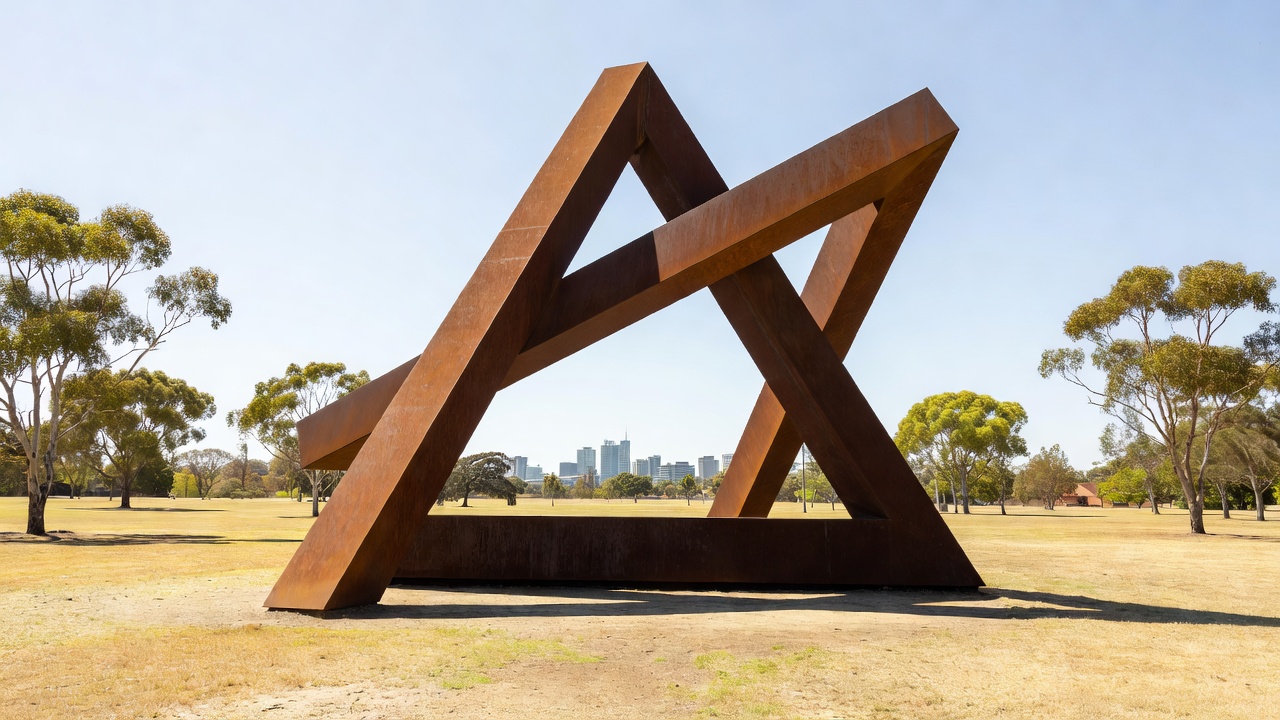
Sculptors can make impossible objects appear real from one carefully chosen viewpoint. The beams are actually separated in depth, or bent, and line up only when seen from the right spot. A well-known public example is the large Impossible Triangle sculpture in East Perth, Australia, unveiled in 1999.
Walk a few steps sideways and the illusion falls apart, which shows that the "impossible" part was never the object. It was the single viewpoint that a drawing forces on us.
Draw your own
Isometric dot paper makes this easy. Draw a large triangle, then a smaller one inside it, and connect them with short lines parallel to the sides. Shade each L-shaped panel differently and the beams will suddenly seem to twist.
Drawing slowly is a lovely way to feel the moment where the shape becomes impossible under your own pencil.
"Each corner tells the truth. The lie only appears when they tell their stories together."Puff Puzzle Mang editorial note